

For the past seven years, we have invited international craftspeople to apply for our New Makers programme. The successful artists receive expert guidance on their growing businesses, along with a platform on TOAST to sell their handcrafted goods. We started this annual non-profit mentorship to broaden the expression of our brand values, centering around thoughtful production and the preservation of centuries-old techniques. This year’s makers were chosen for their novel and inspiring approaches to such crafts.
Craft is a verb. There is no fixed end, or point of completion. For our makers, it is a life of experimentation: refining their practice and cultivating an awareness of the world of natural materials.
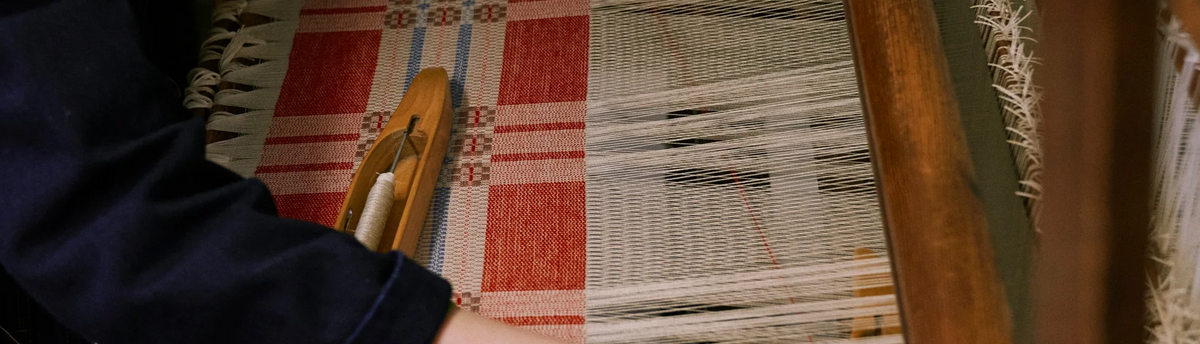
Handweaver Sabine Van der Sande creates textiles inspired by archival weaving patterns. “I love the intimacy of textiles,” she says. “People throughout history have worn them close to the skin - it’s the fabric of life.”
THE THROW
For each throw, 500-600 individual threads have to be wound onto her historic nineteenth-century hand loom. Coverlets found in migrant homesteads in early North American homesteads have been a central inspiration to her dedication to handcraft. “Working with very simple looms, women would create these amazing coverlets as the sole decorative item in a home with one room. These beautiful hand woven pieces were one of the only ways women could express themselves.” Her designs for TOAST have been updated with a vibrant colour palette, and more elaborate designs have been simplified, building on the negative space in her textiles.
Lærke Møller Hansen is a ceramicist working in Nexø, a fishing town on the east coast of Bornholm, a Danish island in the Baltic sea. “There’s so many stages in mastering ceramics,” Lærke says. “It makes me very excited to work with clay. Its state is shifting all the time. As a material, it has so much to say.”

CERAMICS
JEWELLERY
This intuitive, material-led approach resonates with woodworker Elise McLauchlan, who also discovered her craft through a deep sensitivity to material. Once a metalworker herself, Elise found wood to be a more forgiving medium: “It’s alive, always warping and changing shape,” she says.


